
Author: Jarmo Tuisk
One person discovers a completely new pace of work with AI. Texts get written faster, analyses take their first shape in minutes, and meeting notes turn into summaries almost automatically. Work that used to take a week now fits into a couple of days, or even half a day.
Then someone looks at the organization as a whole and an uncomfortable question appears: why is all this still not showing up as a major change?
This is one of the most common paradoxes of AI adoption right now. Individual productivity can grow very quickly, while the organization’s overall results move much more slowly. In most cases, the change does not get stuck because the tools are bad or people are lazy. The friction appears in the system, where AI capability is unevenly distributed across the organization.
The same tension is visible in software development research. The DORA generative AI report associated a 25% increase in AI adoption with higher individual productivity, while software delivery throughput was estimated to be 1.5% lower and delivery stability 7.2% lower. The later 2025 DORA report showed that in stronger environments, AI can have a positive effect on throughput, but stability, quality, and organizational bottlenecks remain leadership questions. In other words, people may feel and even measure personal acceleration, while the system-level outcome does not improve at the same pace.
AI impact is not determined only by the strongest users. Very often, it is determined by the narrowest point in the system: the roles where AI is used the least or where people benefit from it the least.
Organizational productivity does not grow at the pace of the best individual
AI is often discussed through the lens of individual gains. How much faster can someone write? How much faster can someone create a summary? How much time can one manager, analyst, marketer, or developer save?
These questions matter, but at the organizational level they are not enough.
If one person’s work speed grows by 80%, it does not automatically mean the whole team’s output grows by 80%. Work does not move in a straight line from one person’s desk to a finished result. Most valuable work moves through roles, decisions, approvals, documents, meetings, quality control, and customer communication.
If one link in that chain moves very fast with AI, but the next one works at the old pace, the bottleneck simply moves forward.
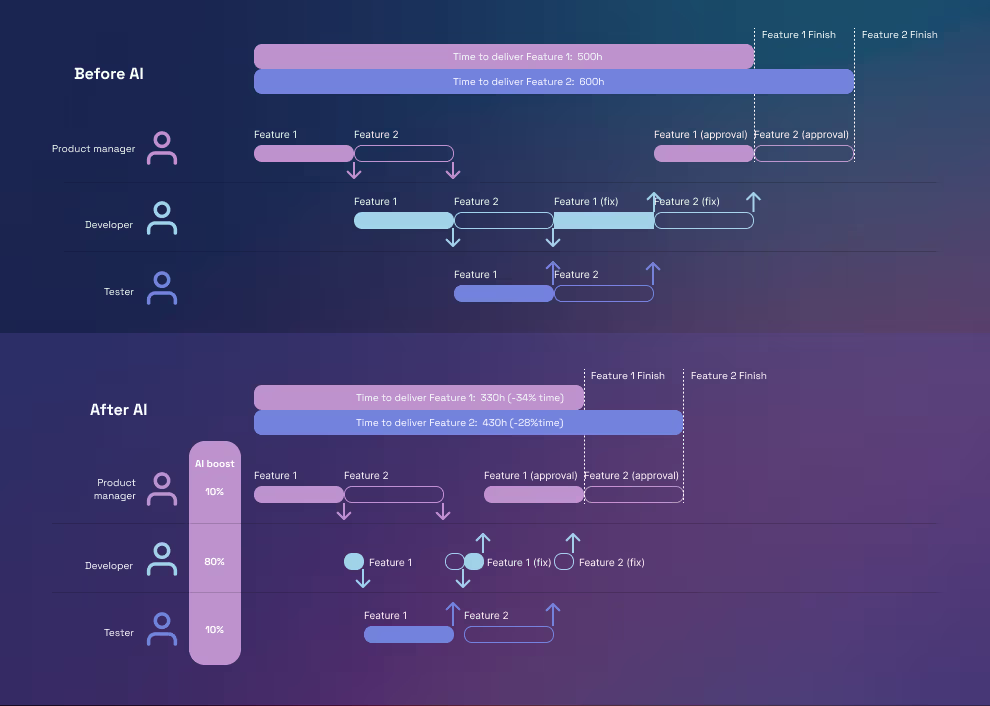
For example, a developer may write code five times faster, but testing still takes the same amount of time as before. The overall speed improves only in one part of the flow and creates dead time that does not help the system much.
Eliyahu M. Goldratt’s theory of constraints explains this well: a system’s throughput depends on the constraint, not on its most capable part.
In project management terms, the pace of the whole project depends on the critical chain: the activities and dependencies whose delay affects the final result. The same logic applies to AI adoption.
If some people in a team use AI every day while others use it uncertainly or only occasionally, the team’s total productivity will not grow at the same pace as its strongest users. Growth gets stuck at the work stages where one person’s output has to move smoothly into the hands of the next person.
A typical example is a situation where one employee or a small group becomes the organization’s “AI superuser.” At first this looks very positive. Someone can help, demonstrate, fix, prompt, and choose tools. After a while, however, a new dependency appears: all the more difficult AI questions move to one or two people.
The other version is even more subtle: the superuser is not overloaded, but idle. Their part of the work gets done quickly with AI, but the next link is not ready to receive it, review it, or move it forward. This creates dead time: the capability exists, but the system does not allow it to be used.
This does not mean superusers are unnecessary. Quite the opposite, they are very useful. But a model that depends only on superusers does not scale. The real organizational gain appears when baseline skills rise more broadly and critical roles can use AI inside their own workflows, rather than through someone else.
Uneven AI capability is a leadership problem
AI adoption is often treated as a question of tool selection or training needs. Both matter, but the bigger question is leadership.
When AI skills are unevenly distributed, several invisible brakes appear inside the organization.
First, there is a difference in pace. Some people quickly get used to creating first drafts, summaries, analyses, and alternatives with AI. Others continue to start from zero. Inside the same workflow, people begin to operate at different speeds.
Second, there is a difference in quality. An employee who uses AI well can test more alternatives before making a decision, check objections, and structure material more clearly. If another employee uses AI randomly or not at all, output quality becomes uneven.
Third, there is a difference in trust. Some people have learned to check, refine, and limit AI answers. Others fear the tool’s mistakes so much that they avoid it completely. In both cases, the issue is not only skill, but also understanding risk.
Fourth, there is a difference in language and working methods. If one team talks about prompts, workflows, and agents while another team is still not clear on the difference between ChatGPT, Copilot, and ordinary search, collaboration becomes harder. The same organization starts to use several different technological languages at once.
These differences do not necessarily show up as major conflicts. More often, they appear as small delays, repeated explanations, uneven results, and unused opportunities.
AI adoption has to be viewed as a workflow question, not a tool question
If the goal is organizational productivity growth, it is not enough to ask: “Who uses AI?”
A better question is: “In which workflows should AI have an effect, and where does that effect currently get stuck?”
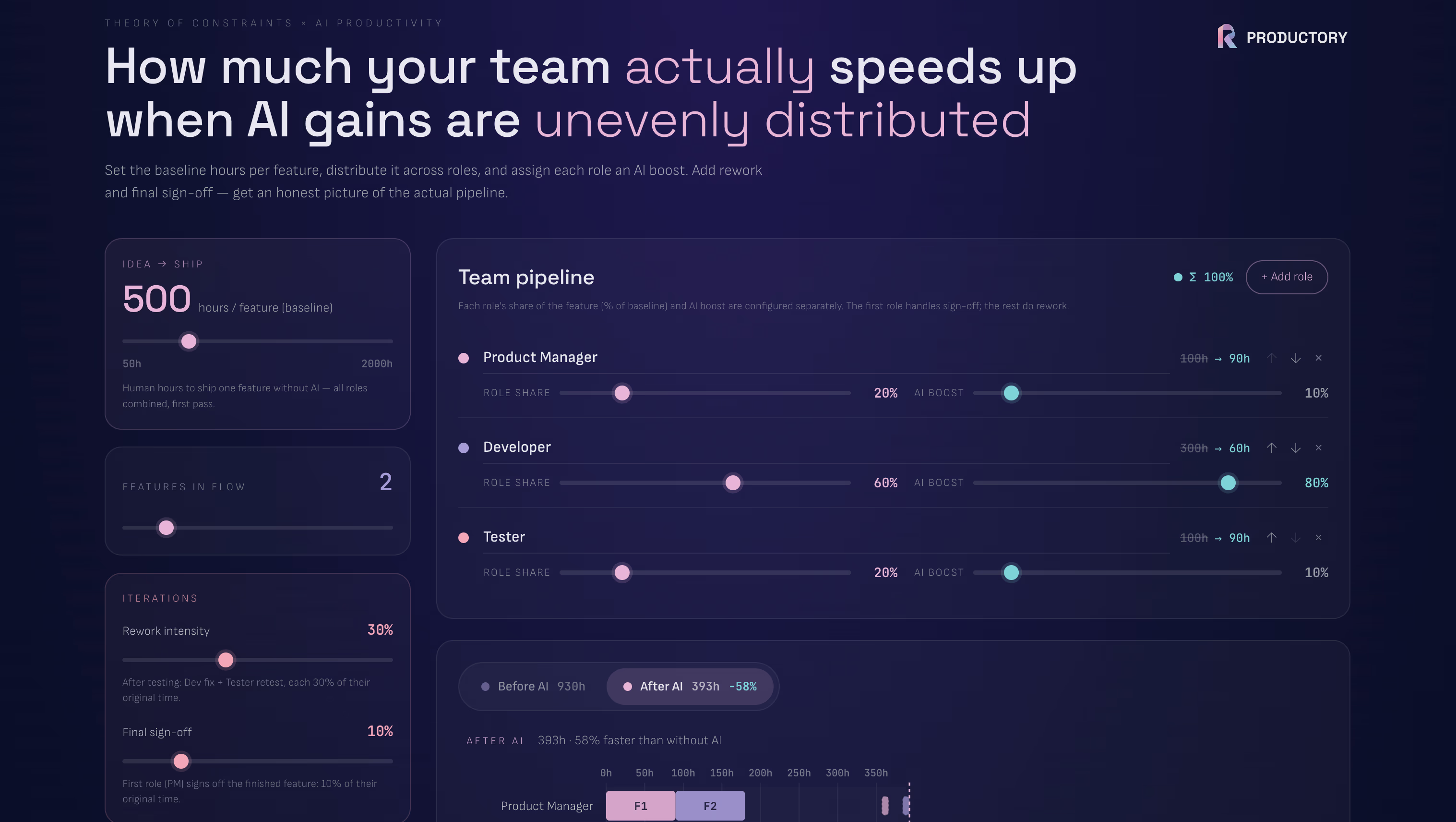
To find that bottleneck, you can also use our free tool: AI workflow bottleneck modeler.
It lets you define the baseline volume of a workflow, the share of work done by different roles, each role’s AI amplification, and the effect of rework and final acceptance. It is not a precise ROI calculator, but it gives you a quick way to see how unevenly distributed AI capability can speed up, slow down, or create unexpected dead time across an entire workflow.
“Let’s train everyone” is not wrong, but it is not enough
Organization-wide baseline training is often a necessary first step. It creates a shared language, reduces fear, and helps people understand what AI can actually do.
But baseline training alone does not remove every bottleneck.
If everyone receives the same general introduction, but the critical roles in a workflow do not learn their specific use cases, the impact stays shallow. A manager needs different exercises than a lawyer. A communications team needs different working methods than a financial analyst. A project manager needs a different kind of AI use than a customer support specialist.
That is why a staged approach works better.
First, raise the organization’s baseline to a level where people share enough understanding and vocabulary. Then move to roles and workflows: which tasks in this specific work can actually be made better with AI? Finally, move to implementation projects where teams build or test concrete solutions on their real work.
This does not have to be a large and complicated program. Often a very practical sequence is enough:
-
shared baseline training;
-
role-based workshops;
-
AI audits of 2-3 selected workflows;
-
small pilot projects;
-
documentation of shared guidelines and best practices.
The important thing is not to confuse activity with impact. A lot of AI experiments do not yet mean systematic productivity growth. Impact appears when experiments are connected to workflows, responsibilities, and measurable constraints.
One person cannot make their thinking infinitely parallel
AI enables parallel execution. One person can ask AI to create several drafts, compare alternatives, summarize information, and suggest solution paths.
But human attention is still limited. One person can still meaningfully think about only one thing at a time. When AI creates more options, more drafts, and more possibilities, a new question appears quickly: who will evaluate them, choose between them, take responsibility, and connect them into a whole?
This is why the goal of AI adoption cannot simply be more output. The goal should be better throughput: less waiting, less repetition, better decisions, and clearer responsibility.
The same problem is easy to see in software development. If a machine can generate three pull requests in parallel, that does not mean a human can review them three times faster. Review requires attention, context, risk assessment, and responsibility. Machine work can run in parallel, but human thinking still moves sequentially.
If AI only increases the amount of input while decision-making and coordination capacity do not grow, the organization can become even more blocked. Everyone produces faster, but no one has enough time to think everything through.
Good AI implementation helps free human thinking for the places where it is needed most: decisions, priorities, quality judgment, understanding customer relationships, and creating new solutions.
How to start
The first step does not have to be a major technology decision. Often it is better to start with a simple question:
Which important organizational workflow would move faster or become higher-quality if all participating roles could use AI at a baseline level?
Then look not only at who is most advanced, but also at where the whole system is currently getting stuck.
A practical start could look like this:
-
choose one visible and sufficiently recurring workflow;
-
map the roles that participate in it;
-
assess the AI usage level of each role;
-
identify the highest-impact skill or process gap;
-
run a targeted training session or workshop for that gap;
-
measure whether the workflow actually became faster, clearer, or higher-quality.
This approach makes AI much less abstract. The question is no longer only whether the organization “uses AI.” The question is whether AI helps a specific piece of work move better.
In conclusion
AI does not automatically raise organizational productivity. A few highly capable users are valuable, but they do not yet change the whole system.
The real impact appears when AI skills, working methods, and responsibility become more evenly distributed across the organization. It is especially important to find the places where work actually gets stuck today: decision-making, approval, data preparation, management, quality control, or baseline skills.
The leadership question of AI adoption is not: “How do we make a few people very fast?”
A better question is: “How do we raise the throughput of the whole system?”
Productory’s AI trainings and development programs are built around exactly this logic: first a shared baseline, then role-based workshops, and finally the implementation of concrete workflows. This way, AI impact does not remain at the level of a few enthusiasts, but starts to move into the organization’s real results.